What to include in an accident diagram: a practical checklist
Published: 2026-08-07
Written and reviewed by the My Traffic Sketch editorial team · How our guides are made
Two diagrams of the same crash can be worlds apart: one answers every question at a glance, the other raises more questions than it answers. The difference is rarely artistic skill: it is completeness. Here is what belongs in an accident diagram, and what does not.
The non-negotiables
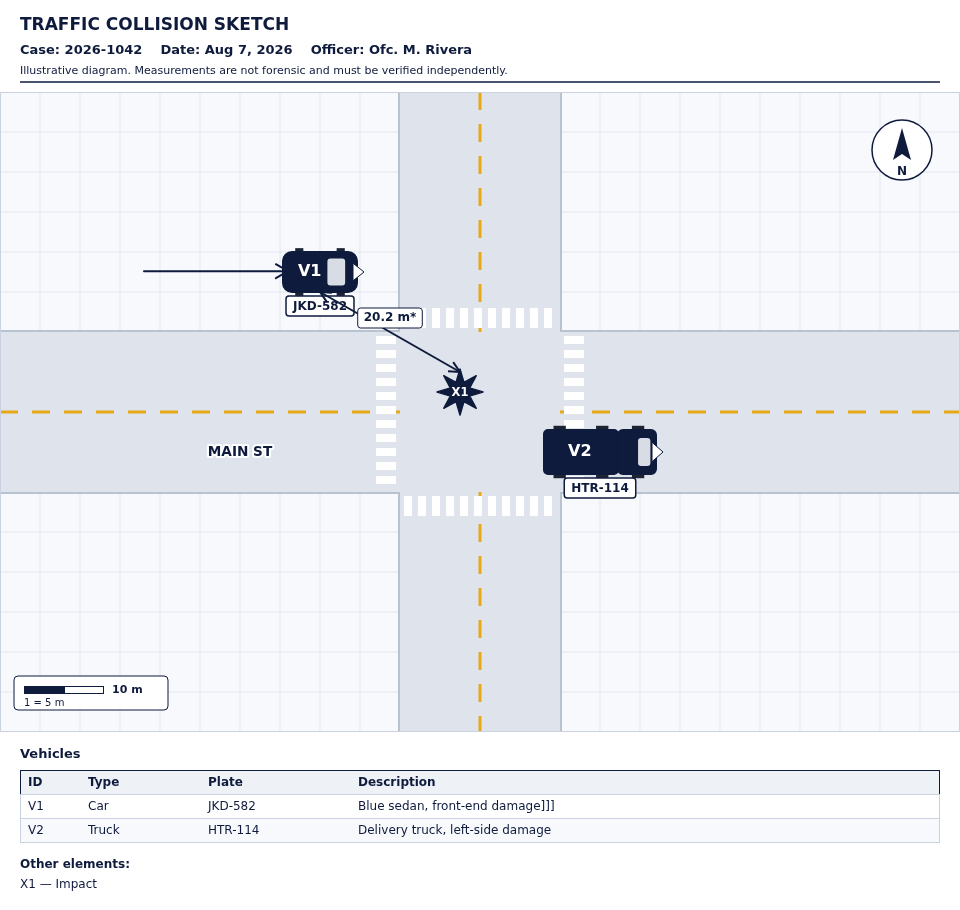
Every accident diagram, no matter how simple, should contain:
- ▸The road layout, recognizable enough that someone who knows the location says "yes, that's the place".
- ▸Every involved vehicle, positioned and rotated as it was at impact, labeled V1, V2…
- ▸A direction-of-travel arrow for each vehicle.
- ▸The point of impact, marked explicitly with its own symbol.
- ▸Traffic controls that governed the movement: signs, lights, lane markings.
- ▸A north indicator and, if any distances are shown, a scale reference.
A worked pass through the checklist
Take a simple two-vehicle collision and walk the list. V1, a gray sedan, travels north on Main Street and begins a left turn onto 3rd Avenue. V2, a motorcycle, travels south on Main through the intersection. They meet inside the intersection, roughly in front of the southbound left lane. (All positions and distances in this example are illustrative. Your diagram records what you actually observed.)
Applying the checklist: the 4-way template gives the road layout; V1 is drawn mid-turn at about 45 degrees with a curved arrow tracing the turn; V2 is drawn straight in its lane with a straight arrow; X1 goes where the paths cross; the signal that governed the movement sits at the corner; the compass is rotated so north matches Main Street's real direction. Now the same picture answers who, where, which way and under what control: without a word of text.
Notice what the checklist forced into the open: if you cannot place the impact point, you know which question to answer before the scene information is gone. The list is not bureaucracy. It is a memory aid working in your favor while details are still fresh.
Identification turns a drawing into documentation
Add each vehicle's license plate and a short description — make, color, damage area. In My Traffic Sketch these print as a table under the diagram, so the reader never has to guess which rectangle is the Corolla. A useful description is short and physical: "blue Toyota Corolla, front-left fender damage" beats "passenger vehicle".
If people outside vehicles were involved — pedestrians, cyclists — place and label them too (P1, P2…). Their position at the moment of impact matters more than where they stood afterward; if both are relevant, note the second position in the narrative rather than cluttering the drawing.
Measurements: a few good ones beat many rough ones
Include the distances that answer real questions: length of skid marks, distance from the crosswalk, final rest positions. Three verified measurements are worth more than ten guesses. Always treat diagram measurements as illustrative until independently verified.
A practical minimum for most two-vehicle collisions is three dimension lines: one locating each vehicle's rest position from a fixed reference (a curb corner, a pole), and one for the most important path evidence: for example, a skid mark of about 12 m starting in V1's lane. Label estimates as estimates; a paced distance marked "approx." keeps its credibility, an estimate presented as a measurement loses it.
The narrative: three sentences that finish the job
The exported report has space for a short narrative, and it exists to carry the facts a drawing cannot: sequence, weather, light conditions, what each driver said they intended. "V1 was turning left from Main onto 3rd. V2 was traveling south on Main. Impact occurred inside the intersection; pavement was wet." Three sentences, and the diagram now has a timeline and conditions.
What to leave out
Everything that did not influence the collision: buildings that played no role, every parked car on the block, decorative trees. A diagram is evidence of relevance. If an element did not matter, its presence suggests you thought it did.
The same discipline applies to precision. Do not invent angles to the degree or distances to the centimeter that nobody measured. A clean diagram with honest precision reads as careful; false precision reads as reconstruction you are not claiming to have done.
A quick self-test before you export
Cover the narrative and ask someone who was not there:
- ▸Can you tell which way each vehicle was going?
- ▸Can you point to where they collided?
- ▸Can you tell which vehicle is which, by plate or description?
- ▸Can you orient the scene: which way is north, which street is which?
- ▸Is anything in the drawing that you have questions about. And does it matter?
Ready to draw your own diagram? The editor is free and needs no account.
Open the free sketch tool